


Quick Links
AI, Taxonomies, and Frameworks
Developing Assignments in the Time of AI (AI-Resistant Assignments)
Providing Guidance to Students
The impacts of AI on course design and assessments of learning continues to evolve as the world of AI evolves, but we can plan for how to integrate AI intentionally or encourage students to not use AI with purpose.
AI Literacy
From predictive text in our emails to patient notes after a doctor visit, AI is prevalent in our lives. With any new technology, our first reaction could take many forms: excited curiosity, skepticism, blissful ignorance, avoidance, and fear. However, AI, and in particular generative AI, is being used heavily in industry and disciplines. It will be essential that our students develop an AI Literacy and become responsible users of AI platforms.
What is AI Literacy?
AI Literacy is a philosophical approach aimed at preparing students and our disciplines for developing an agile, ethical approach to this technology. From understanding the basic functions of generative AI to critically evaluating the use of AI and its ethical ramifications, AI Literacy seeks to educate students on the how, why, and when of ethical AI use
Quick Videos to Share with Students
Here are two quick student-facing videos from the University of Louisville’s Citizen Library.
What is AI Literacy and Why is it Important?
Should I use Generative AI?
Generative AI and Bloom’s Taxonomy
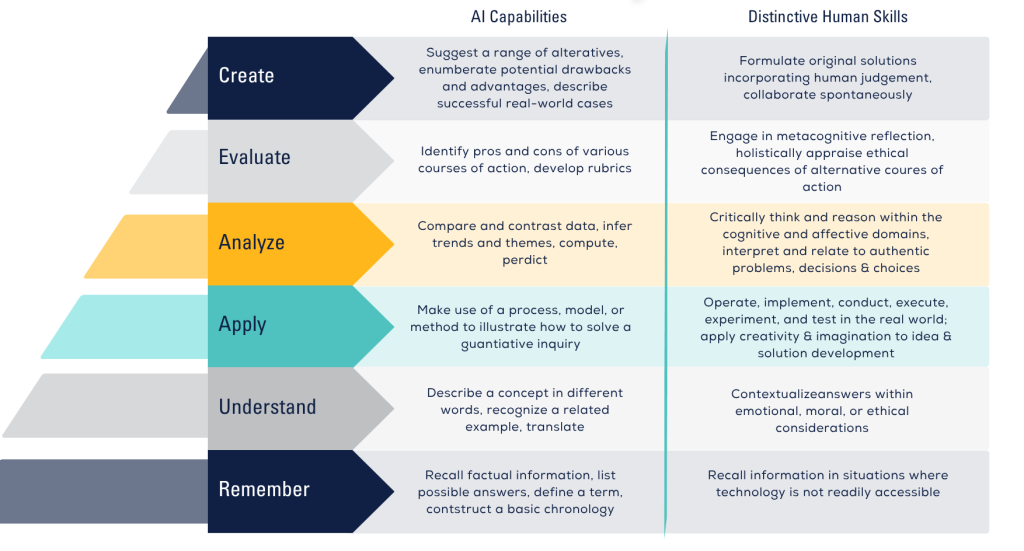
Oregon State’s Bloom’s Revisited
In the Advancing Meaningful Learning in the Age of AI, Oregon state considers an alignment between AI use and Bloom’s Taxonomy, articulating what capacity AI has to complete tasks at each level of Bloom’s in comparison to the distinctive skills that only humans can perform.
Inverted Bloom’s Taxonomy
In the Teaching with AI: Trends, Tensions, and Transformations in Higher Education (2025), Kassorla suggests the Inverted Bloom’s Taxonomy may be a helpful approach with AI. In the Inverted Bloom’s learners “create-first and deconstruct-later” and move through Bloom’s in reverse. Kassorla believes this shift will “…introduce ‘productive friction’— the cognitive effort required to transform a superficial, machine-generated artifact into something demonstrating true ownership and insight” (p5).
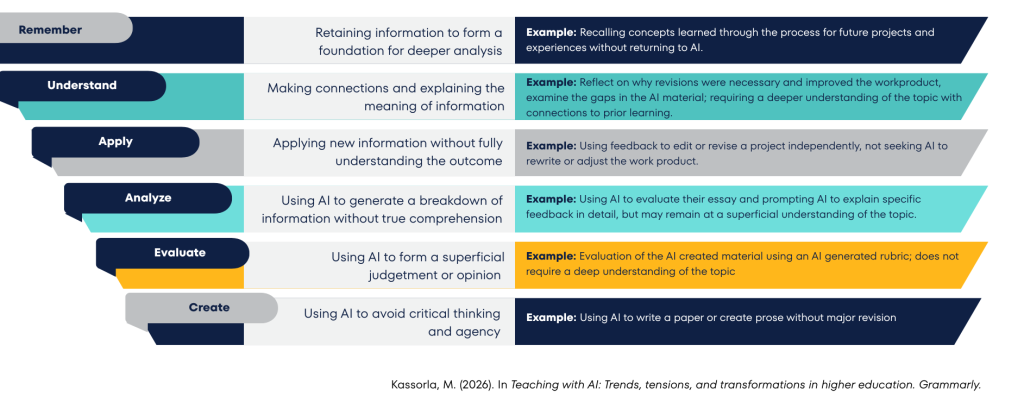
Kassorla provides sample assignments for each level of Inverted Bloom’s in her original blog post on the Academic Platypus.
(Digital Promise) AI Literacy: A Framework to Understand, Evaluate, and Use Emerging Technology
Digital Promise, a global, non-profit focused on educational access, conducts research in learning sciences and educational technology. In 2024, they developed an AI Literacy Framework with corresponding resources for integrating AI Literacy skills into the curriculum.
The framework outlines three key areas of AI Literacy development: Understanding AI, Using AI, and Evaluating AI. Additionally the framework outlines specific practice areas within each area:
| Understanding AI | Using AI | Evaluating AI |
|---|---|---|
| Understanding Algorithmic thinking, abstraction and decomposition; Data Analysis and inference; Data Privacy and security; Information and mis/disinformation; Ethics and impacts; Digital Communication and Expression | Creating AI; Interacting with AI; Using AI for Problem Solving | Information and mis/disinformation; Ethics and impacts; Digital Communication and Expression; Data Privacy and security; Data Analysis and inference; Understanding Algorithmic thinking, abstraction and decomposition |
AI-Resistant Assignments
Can I make an assignment AI-proof, and ensure that students are not using AI when it is not appropriate? There is some debate on whether an assignment can truly be AI-proof, with most scholars asserting that our aim should be creating AI-resistant assignments. AI-resistant assignments provide learners with clear boundaries for AI use, while asking learners to document their learning process.
Tips for AI-Resistant Assignments
- Reflection: assignments that ask students to reflect or connect through reflection to prior learning are more challenging for AI to replicate.
- Process: assignments that are scaffolded requiring learners to demonstrate their process for development (show their work) make AI use visible.
- Collaborative or Team-based: assignments that include peer brainstorming, peer-review, or collaborative development lower AI use while increasing socio-emotional learning.
Quick Resources for Developing AI-Resistant Assignments
EdTech Specialist: 10 Easy Ways to Create AI-Resistant Assignments
Colorado State: AI Resistant assignments
UCLA: Creating Assignments that Eliminate AI Use
GPTZero: How to ChatGPT-proof assignments
UMass: How do I (re)design assignments and assessments in an AI Impacted World

After exploring some generative AI tools, instructors will need to decide how to discuss this technology with their students, consider potential policies around its use and revisit some of their assessments in their courses.
There several free resources to help departments and faculty frame the appropriate use of AI at the course-level:
Setting the Expectation
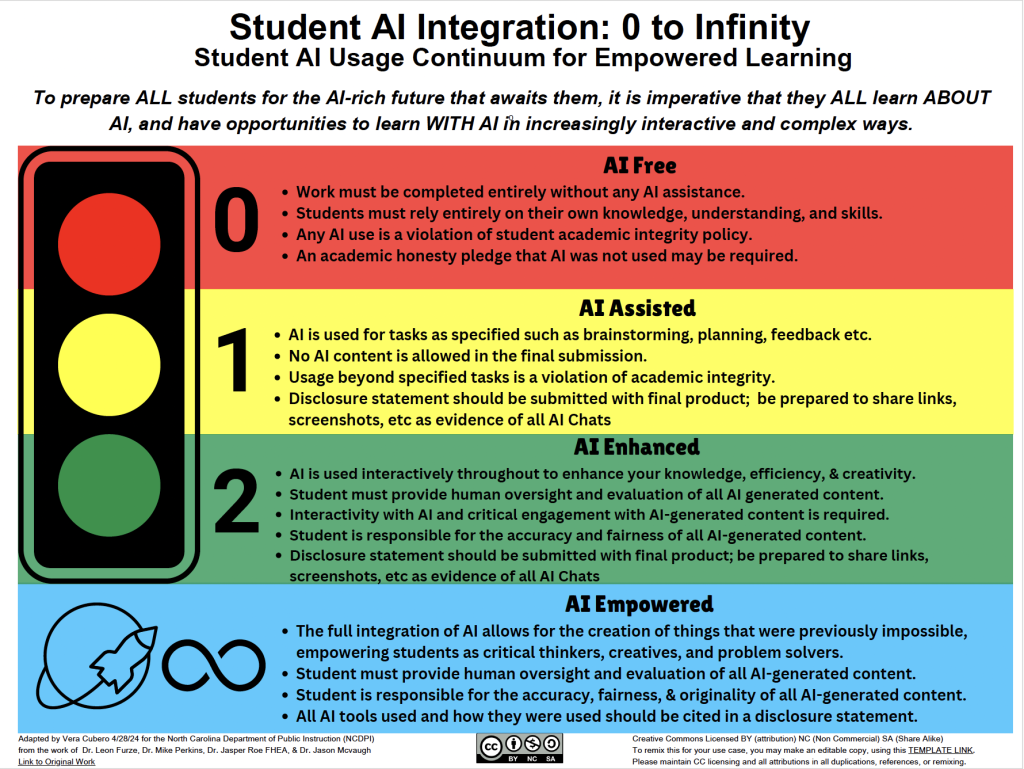
Using common language across courses in a discipline can reduce learner confusion on when to use AI. Perkins, et. al (2024) The AI Assessment Scale (AIAS): A Framework For Ethical Integration of Generative AI In Educational Assessment offers a research-informed framework and scale for AI integration in courses.
Easy to Use Framing:
This handy Creative Commons licensed graphic and PDF for the AIAS framework is free to use and offers easy to understand language outlining course-level use of AI.
Ideas for Consideration:
- Students may lack a clear process for creating scholarly work. Consider surveying students at the beginning of the semester to share their current process for completing their coursework. For instance, how do they approach research? What’s their experience in creating citations? How do they tackle bigger projects like papers and presentations? Knowing this information can suggest relevant ways to discuss how to approach course work and ethical uses of generative AI.
- Students may be new to generative AI technology. Don’t assume that because generative AI is in the news that your students already know how to use it. If there is concern about students using this technology unethically, discuss the technology as a class. Discuss academic honesty and ethical uses of this technology. Explain what role generative AI should play in the course. Add language to the course-level information and policies that clarifies expectations of generative AI use.
- Students rely on instructors to develop a scholarly process. Scaffold large assignments to help students learn the process of learning and critical thinking. Use smaller, reflective assignments to help students learn and practice specific steps in the scholarly process.
- Students need to know how generative AI will be used in their field of study. Discuss with students how professionals are using this technology. Consider bringing in a guest speaker from your field to discuss this technology and ask questions.
- Students value assignments that are authentic and give students agency. Consider revisiting some assignments that encourage students to analyze the output of AI generators. For example, instead of asking students to write a paper, generate one or more papers from a generative AI source and ask students to analyze the output with some guiding questions.
- Students don’t come to college with the intention to cheat. Create a class environment that encourages students to feel comfortable approaching you and others when they need support.
Providing REsources and Guidance
Like any emerging technology, students may or may not be experienced in using GAI or understand the best approach to doing so. Moreover, information and perspectives tied to this technology are continuously evolving faster than our documentation and scholarship processes. This rapid progression is tied to the very nature of generative AI.
Students need clarity on how to use AI ethically in your courses and in their scholarly work. Harvard Business Publishing developed a Student Use Cases for AI: Start by sharing these guidelines with your class (2023) resource that can help your students understand four key uses for AI in learning: AI as feedback generator, AI as personal tutor, AI as team coach, AI as learner.
Consider when using AI in your course might be a helpful tool, and give students examples and context for its use.