


The University Teaching and Learning Commons (UTLC) is committed to supporting student learning and success through the promotion of and engagement in high-impact teaching, learning, and mentoring practices. The UTLC offers a wide range of resources and programs designed to foster innovative teaching, improve instructional methods, and encourage continuous professional growth. Whether you’re seeking guidance on curriculum design, exploring new teaching technologies, or pursuing faculty development opportunities, the UTLC is here to support and empower you every step of the way.
For nearly a decade, the UTLC has embraced the principles of Universal Design for Learning (UDL) as the foundation of our work. In recent years, UDL has become the cornerstone of UTLC programming, guiding quality course design and teaching practice that supports student success. As CAST.org explains, “UDL aims to change the design of the environment rather than to situate the problem as a perceived deficit within the learner. When environments are intentionally designed to reduce barriers, every learner can engage in rigorous, meaningful learning.”
Grounded in research on the neuroscience of learning, the UDL Guidelines, —developed by CAST—translate UDL principles into actionable strategies. These guidelines “offer a set of concrete suggestions that can be applied to any discipline or domain to ensure that all learners can access and participate in meaningful, challenging learning opportunities.”
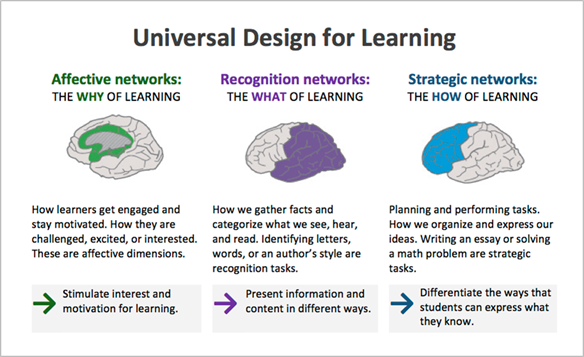
The UDL Guidelines focus on three key areas of the learning process, each aimed at promoting learner agency:
- Multiple Means of Engagement – the why of learning: How do we motivate and inspire learners to connect with the course material, experiences, and content?
- Multiple Means of Representation – the what of learning: How do we design courses, course materials, and activities to support students in navigating the learning process effectively?
- Multiple Means of Action and Expression – the how of learning: How do learners demonstrate their understanding and the learning process in varied and meaningful ways?
The University Teaching and Learning Commons (UTLC) at UNCG has evolved significantly over the past several decades, reflecting broader changes in the field of faculty and educational development. From its early days as the “old TLC,” offering workshops, training sessions, instructional videos, and equipment services, to today’s modern UTLC, the purpose has remained consistent: to support student learning and success in an ever-changing academic landscape.
Throughout its history, the UTLC has undergone several name changes—many of which you may still hear around campus—including:
Today’s UTLC is a comprehensive hub dedicated to supporting all instructors in the practice of teaching and learning. We also provide leadership development, faculty mentoring programs, and guidance on academic policies and teaching-related initiatives.
The term faculty development has traditionally been used to broadly describe programs and services that support faculty growth in both professional and instructional domains. Over the past decade, however, a more nuanced understanding has emerged. Today, faculty development often refers to career and professional advancement within the professoriate, while a newer term—educational development—has gained traction to describe efforts focused specifically on instructional improvement. Although this distinction is recognized within professional circles, the terms are still frequently used interchangeably. Professionals in the field are commonly referred to as both faculty developers and educational developers.
The roots of faculty and educational development stretch back nearly a century, but the modern era of teaching and instructional support began with the establishment of the Center for Research on Learning and Teaching (CRLT) at the University of Michigan formed in 1962 (Tiberius, 2002). CRLT remains a model for teaching and learning centers, offering both immediate instructional support—such as consultations and workshops—and proactive development in pedagogy, teaching strategies, and learning science. While structural models vary—from centers that integrate student and instructor support to those focused solely on the scholarship of teaching and learning—modern faculty and educational development units serve a vital role. They act as a bridge between educational theory and the practical realities of teaching and learning in higher education.
To explore the history of faculty and educational development by visiting the POD Network and reading Tiberius’ (2002) A Brief History of Educational Development: Implications for Teachers and Developers.

The POD Network
The UTLC is a member of the POD Network, also known as the Professional and Organizational Development Network in Higher Education. POD, as it is often called, is the US and Canadian professional organization for educational developers and spans a network of 1500 higher education institutions.

Association for Undergraduate Education At Research Universities (UERU)
UNCG is an institutional member of the Association for Undergraduate Education at Research Universities (UERU). UERU is a national network of R1 and R2 universities focused on undergraduate education and student success. With dedicated working groups for academic advising, teaching and learning centers, college admissions, STEM education, and more, you can learn more about UERU at UNCG by emailing the UTLC@uncg.edu.
American Association of Colleges And Universities (AACU)
UNCG is an institutional member of the American Association of Colleges and Universities (AACU). All faculty and staff have access to AACU’s vast research and resource network on curriculum design, educational policy, student success, and the democratic purposes of higher education globally. You can create an AACU account using your UNCG email.
Student Experience Project (SEP)
UNCG is pleased to be joining the Student Experience Project, a multiyear, multi-institution to enhance student outcomes through partnership between faculty, staff, and administration. A collaboration of the, Association of Public and Land-grant Universities (APLU) and Coalition of Urban Serving Universities, the SEP puts into place research-backed teaching practices that focus on campus climate and culture to improve academic outcomes for students and faculty success. Our 2026/2027 focus will be building a pilot community of practice for targeted faculty support and disseminating information from the SEP to campus in general through workshops and other professional development opportunities.
Learn more about the UTLC and Division of Student Success partnership with SEP.

Association on Higher Education and Disability (AHEAD)
The UTLC team are members of the Association on Higher Education and Disability (AHEAD). AHEAD an international organization that supports professional development, networking, policy and emerging issue development, and research for creating accessible higher education experiences for learners with disabilities.