Emotions And Learning
Understanding how emotion impacts learning and engagement is the foundation of trauma-informed teaching. The graphic below outlines three levels of brain engagement that maybe impacted by the emotion of the current election cycle:
Green Brain, Yellow Brain, Red Brain
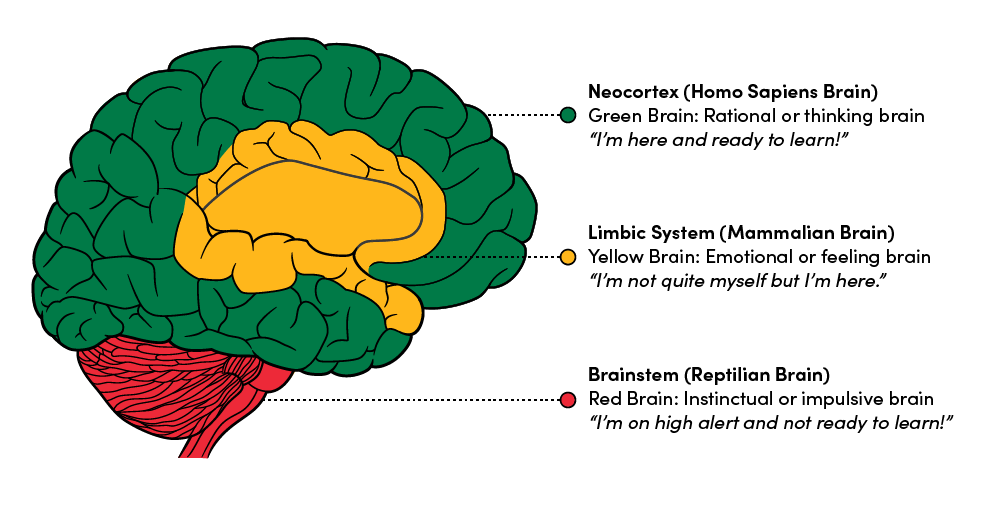
When students are preparing to learn, they are often in one of three brain states: Green Brain, Yellow Brain, or Red Brain.
- Green Brain is the optimal state for learning, as the brain is attentive and ready to focus. This brain state is often associated with calm and rational logic.
- Yellow Brain is indicative of a someone dealing with something difficult, but not life threatening, outside of the classroom space. This brain state is often associated with an emotionally heightened state. For example, if a student’s car didn’t start in the morning, they may be present in class but likely still holding mental and emotional space as they try navigate getting their car fixed. Though the student may want to engage in the learning, their mind is occupied with other things. The Yellow Brain state can happen for a number of situations and scenarios, including the outcome of a large national election.
- Red Brain is indicative of someone dealing with a life or death situation or something that has the potential to significantly change their life. This brain state is often associated with instinctive response. Many neuroscientist call this a survival state – “I am on high alert and preparing for threats.”
During a crisis or challenging global moment, students may experience any variation of these brain states. Instructors should be prepared for students to have varying or weaning engagement levels.
Understanding Psychological Saftey: The SCARF Model
Neuroscientist David Rock introduced the SCARF model in 2008 to better understand the impact of emotion and motivation through the lens of psychological safety. The model outlines five emotional dimensions that impact how people are present in a specific space or situation: Status, Consistency, Autonomy, Relationships, and Fairness. SCARF can help educators better address psychological safety in our learning spaces and understand how trauma may be present. Students exhibiting trauma-based responses could be experiencing threats on any of the five emotional dimension (in our spaces or in other areas of their lives).
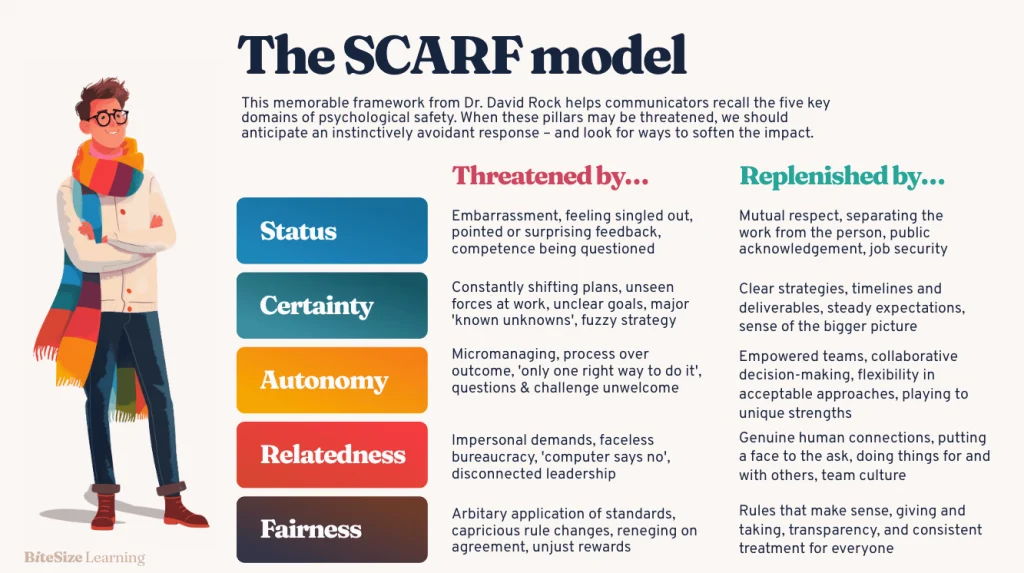
An accessible version of this chart can be found at BiteSize Learning, the original author of the graphic. BiteSize Learning offers additional resources and examples of how to apply SCARF in your daily work.
Strategies for Helping Students Navigate Difficult Moments
- Lighten the Load: During moments of heightened emotion it will likely to difficult for students to engage and stay focused. For global or community trauma, plan or reorganize your course content during this time to focus on application of concepts already learned. It is likely that new content will not be retained.
- Provide Space: Depending on your subject matter, consider how you can provide students with the opportunity to process or acknowledge the emotion of the moment. Providing time for students to independently reflect on what they are feeling can be helpful. You may be able to provide space for students to share with each other, but it is okay if you do not have the space or capacity in your course. Simply providing space for students to acknowledge their emotion can be helpful.
- Connecting to Your Content: Depending on your subject matter, you may be able to connect the moment to your course content. This can provide students with an academically detached outlet. Academic detachment is often our first space of learning, it is when we focus on the scholarship of an idea and not our personal emotions, such as “what does the literature tell us about…” or “what do scholars say about…” Academic detachment can help students remove their personal feelings and focus on something concrete that is outside of themselves as a starting place.
- Differences Between Dialogue and Debate: As instructors, we often hope to get our students to a place of dialogue with one another about difficult topics. This can be difficult if our students have not spent time learning about the difference between dialogue, discussion, and debate. Consider giving your students a brief primer on dialogue/discussion/debate and be explicit about which of the three you are asking them to participate in.
- Debate focuses on the development of counterarguments. Often used to arrive at a winning conclusion, debate can be useful for weighing ideas against each other. Emotion can be high during debate.
- Discussion focuses on the conceptual and is rooted in academic detachment. Often used to explore concepts using established data, discussion can be helpful for developing understanding of new ideas.
- Dialogue focuses on establishing shared understanding and meaning. Often used to build community and understanding the lived experience/perspective of others, dialogue can explore areas of differences and conflict, while focusing on shared meaning making.
- Intention and Impact: Helping students understanding the connection between intention and impact can help ground conversations in the humanity of others. Every action has both an intention and impact that are intertwined. Sometimes the negative impact of an action can outweigh the positive intention with which that action was taken. Helping our students acknowledge the impact of an action, while also understanding the intention, can allow students to see the humanity of the other person and keep learning moving forward.
Trauma-Informed Teaching Infographic
The infographic will allow instructors to see teaching through a trauma-informed lens and provides practical tips and strategies to immediately enact in any learning environment.
This infographic is available at go.uncg.edu/trauma-informed-teaching and a fully-accessible Infographic full text (accessible version) with references.