

The UDL Guidelines
The UDL Guidelines, developed by CAST, “are a tool used in the implementation of Universal Design for Learning, a framework to improve and optimize teaching and learning for all people based on scientific insights into how humans learn.” The guidelines are a research-based tool designed to support the implementation of Universal Design for Learning (UDL)—a framework aimed at improving and optimizing teaching and learning for all individuals, grounded in scientific insights into how humans learn. Also, they provide concrete strategies for implementing UDL in any learning environment.
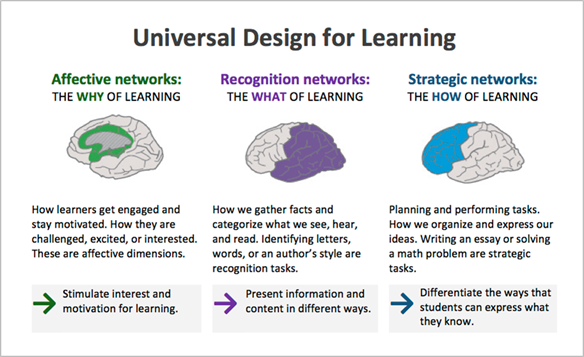
UDL is built around three core principles, each aligned with a major brain network:
- Recognition Network – the what of learning: Focuses on how learners gather and interpret information (Representation).
- Strategic Network – the how of learning: Emphasizes how learners plan and demonstrate their knowledge (Action & Expression).
- Affective Network – the why of learning: Addresses how learners are engaged and motivated (Engagement).
For a deeper understanding of the UDL Guidelines, including a visual overview, visit the CAST UDL Guidelines page or watch the video below.
Rooted in the universal design movement in architecture, Universal Design for Learning (UDL) has been in use for decades and is grounded in the neuroscience of learning. The original concept of universal design was to create spaces that are accessible to all users—spaces where everyone benefits. This same philosophy applies to education: by intentionally designing courses to be inclusive from the start, we can ensure that all learners have access and that every student benefits.
CAST (originally the Center for Applied Special Technology) is a global leader in educational research and accessibility. Founded in 1984, CAST initially focused on using technology to support students with disabilities. Over time, their research expanded to explore how all students learn, leading to the development of the Universal Design for Learning (UDL) framework.
Today, CAST’s mission is to transform education by removing barriers to learning and creating environments where all learners can thrive. Their work continues to shape how educators design inclusive, effective, and engaging learning experiences.


“Ultimately, the goal of UDL is to support learner agency, the capacity to actively participate in making choices in service of learning goals” (CAST.org).
By attending to a six strategic areas, courses can be designed to support learner agency and promote meaningful learning for all:
- Purposeful – internalized self-efficacy, acting in ways that are personally and socially meaningful.
- Reflective – self-awareness and metacognition to identify internal motivations and external influences that support learning and make adjustments when necessary.
- Resourceful – understanding and applying assets, strengths, resources, and linguistic and cultural capital.
- Authentic – increasing comprehension and deepening understanding in ways that are genuine.
- Strategic – setting goals and monitoring learning with intentionality and planfulness.
- Action-oriented – self-directed and collective action in pursuit of learning goals.
“UDL aims to change the design of the environment rather than to situate the problem as a perceived deficit within the learner. When environments are intentionally designed to reduce barriers, every learner can engage in rigorous, meaningful learning” (CAST.org).
This video shows why educators from across the globe are implementing UDL in their learning environments.
UDL also challenges the myth that when we design for the “average” learner then we are designing for most learners in the learning environment.
The UDL Guidelines are operational standards for UDL that “offer a set of concrete suggestions that can be applied to any discipline or domain to ensure that all learners can access and participate in meaningful, challenging learning opportunities.”
The Guidelines are continuously evolving to incorporate the latest research, account for changes in generational needs, and address new technology. Currently, CAST is on using UDL Guidelines 3.0, released in 2024.
The Guidelines focus on three areas of the learning process:
- Multiple Means of Engagement – the why of learning: How do we motivate and inspire learners to connect with the course material, experiences, and content?
- Multiple Means of Representation – the what of learning: How do we design courses, course materials, and activities to support students in navigating the learning process effectively?
- Multiple Means of Action and Expression – the how of learning: How do learners demonstrate their understanding and the learning process in varied and meaningful ways?

Applying the curb-cut effect
Rather than designing for the “average” learner, Universal Design for Learning (UDL) embraces the curb-cut effect, a concept rooted in architectural universal design. Just as curb cuts in sidewalks were originally created to support individuals using wheelchairs—but ultimately benefited everyone (e.g., parents with strollers, travelers with luggage)—UDL designs learning environments that address the needs of students with disabilities and other identities, with all students benefitting from the changes and creating spaces where all learners can thrive.
Baking in Accessibility
One of the key strengths of UDL is its proactive approach to accessibility. Instead of retrofitting accommodations, UDL encourages instructors to integrate accessibility into the design of their courses from the start. This approach reduces the need for individual accommodations and ensures that all students benefit.
Essential for Some, Beneficial for All
While accessibility practices are essential for compliance with university policies and federal/state regulations, they also provide critical support for students with disabilities. When UDL is used to address accessibility, the result is an improved learning experience for all students. A great starting point is to create accessible content—UNCG’s Accessibility Resources site offers practical guidance and tools to help you get started.
Creating Expert Learners
Unlike approaches such as differentiated instruction, which often require tailoring content for each individual, UDL focuses on empowering students to understand how they learn best. This promotes learner agency and self-efficacy. CAST’s resource, Top 5 Tips for Fostering Expert Learners, offers practical strategies to help students become expert learners—where the goal is not just mastering content, but mastering the process of learning itself.
Starting with UDL can feel exciting—and a bit overwhelming. But remember: you don’t have to redesign your entire course to begin. Start by reflecting on your own learning experiences, your current teaching practices, and the variability your students bring to the classroom. A helpful approach is the +1 strategy: make just one small change to apply UDL in your teaching next semester.
For more guidance, visit UDL On Campus for tips on getting started. The UDL Checkpoints infographic is also a great resource, offering examples of teaching strategies aligned with each UDL guideline.
The UTLC holds an annual UDL Institute in August that helps faculty and instructors explore the UDL Guidelines in support of their learning goals.
Check out the resources below to discover more about applying UDL in your teaching:
- UNCG’s Accessibility website with information on UDL
- UDL infographic from the Scholarly Teacher
- ThinkUDL podcast – hosted by Lillian Nave, this podcast features interviews with practitioners who are applying UDL and similar frameworks in their teaching
- UDL in Higher Ed website
- Reach Everyone, Teach Everyone: Universal Design for Learning in Higher Education (Tobin and Behling, 2018) eBook available through the UNCG Library
- UDLHE Network– special interest group (SIG) for UDL practitioners in Higher Education. They offer quarterly meetings, email updates, and an online community to promote collaboration.
- Free, self-paced training: Disability Awareness UDL in Tertiary Education
- Oakland University Christina Moore has 5 minute clips all about UDL
- How do we tell whether Universal Design is working? Webinar featuring Tom Tobin