

Be Transparent. Be Clear. Be Flexible.
When natural disasters or emergencies happen there can be deep impacts our UNCG community. As instructors, it’s important to recognize how these challenges impact students’ ability to learn and engage.

Questions about Remote Instruction
During major events that disrupt daily operations of campus, faculty and instructors may be asked to adjust their instructional modality, likely to remote learning for face-to-face courses. Course already offered online could be asked to adjust from synchronous to asynchronous learning. Understanding options and potential resources can make the transition less frustrating.
Strategies for Going Remote
Quickly moving to remote asynchronous or synchronous learning may seem daunting, but communication and flexibility are your best tools:
- Communication: Be clear, be transparent. Keeping learners informed of course changes and your expectations will serve to ease anxiety and remove ambiguity. Even communicating timelines to address gaps or challenges will be helpful to learners. Like you, learners are dealing with rapid personal and academic shifts, communicating often with intention can help alleviate initial concerns – lightening the load.
- Flexibility: Flexibility and grace for your learners and yourself will make the transition easier. During moments of heightened emotion and anxiety, it will be difficult for learners to engage and stay focused. Learners maybe impacted by the situation differently: Did they lose power? Are they caring for others? Giving students options for completing assignments and being flexible with due dates for one to two weeks after the event may prove helpful.
- Shifting Focus: Plan or reorganize your course content during this time to focus on application of concepts already learned when possible. If providing new content, be prepared to review content when returning to the regular operation.
- Changing Assignments: Consider shifting assignments to independent, reflective work. Remote learning provides a unique space for students to deeply reflect on what they are learning. Jennifer Moon offers an excellent tool for reflective learning practice.
- Videos with Questions: Consider using the video quizzing tool in Canvas Studio that allows you to add quiz questions into your videos ensuring students stay engaged and on track.
- Discussion Boards: Discussion boards can be an excellent alternative to in-person class discussion. However, students are not always prepared for online discussion. Here are a few tips to keep in mind:
- If you are using discussion boards for the first time with your students, give them a few reminders about online learning etiquette.
- Define “discussion” in context of your course or discipline. Without the common cues offered for in-person discussion (e.g., body language, tone, approach), online discussion boards can create confusion for learners, adding guidance or examples of good online discussion interaction can be helpful. Stanford provides a quick guide to developing and role modeling online discussion questions.
Here are a few helpful resources to get you started:
Relationship between Emotions And Learning
Understanding how emotion impacts learning and engagement is the foundation of trauma-informed teaching and helpful during disruptive events. Disruptive events can cause or resurface trauma for many learners. The graphic below outlines three levels of brain engagement that maybe impacted by the emotion of the current election cycle:
Green Brain, Yellow Brain, Red Brain
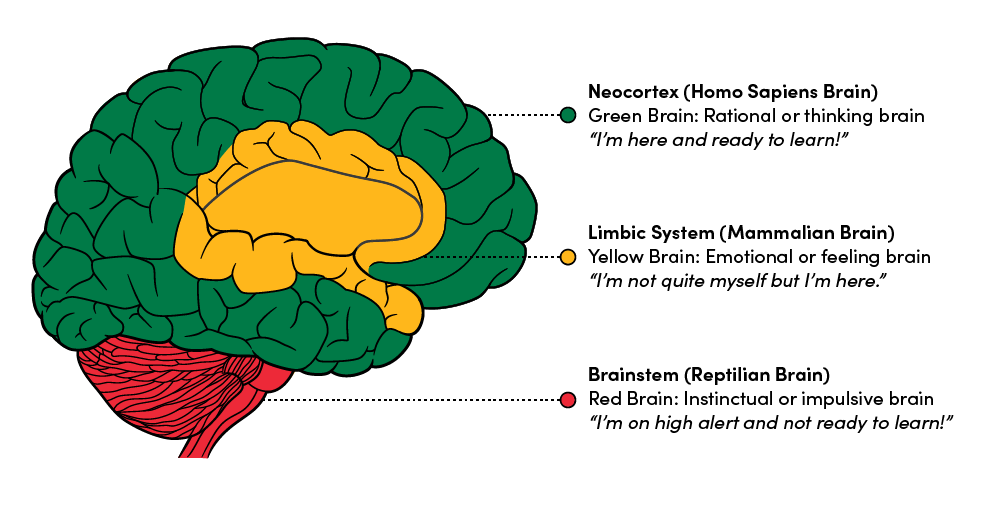
When students are preparing to learn, they are often in one of three brain states: Green Brain, Yellow Brain, or Red Brain.
- Green Brain is the optimal state for learning, as the brain is attentive and ready to focus. This brain state is often associated with calm and rational logic.
- Yellow Brain is indicative of a someone dealing with something difficult, but not life threatening, outside of the classroom space. This brain state is often associated with an emotionally heightened state. For example, if a student’s car didn’t start in the morning, they may be present in class but likely still holding mental and emotional space as they try navigate getting their car fixed. Though the student may want to engage in the learning, their mind is occupied with other things. The Yellow Brain state can happen for a number of situations and scenarios, including the outcome of a large national election.
- Red Brain is indicative of someone dealing with a life or death situation or something that has the potential to significantly change their life. This brain state is often associated with instinctive response. Many neuroscientist call this a survival state – “I am on high alert and preparing for threats.”
During a crisis or challenging global moment, students may experience any variation of these brain states. Instructors should be prepared for students to have varying or weaning engagement levels.
Understanding Psychological Saftey: The SCARF Model
Neuroscientist David Rock introduced the SCARF model in 2008 to better understand the impact of emotion and motivation through the lens of psychological safety. The model outlines five emotional dimensions that impact how people are present in a specific space or situation: Status, Consistency, Autonomy, Relationships, and Fairness. SCARF can help educators better address psychological safety in our learning spaces and understand how trauma may be present. Students exhibiting trauma-based responses could be experiencing threats on any of the five emotional dimension (in our spaces or in other areas of their lives).
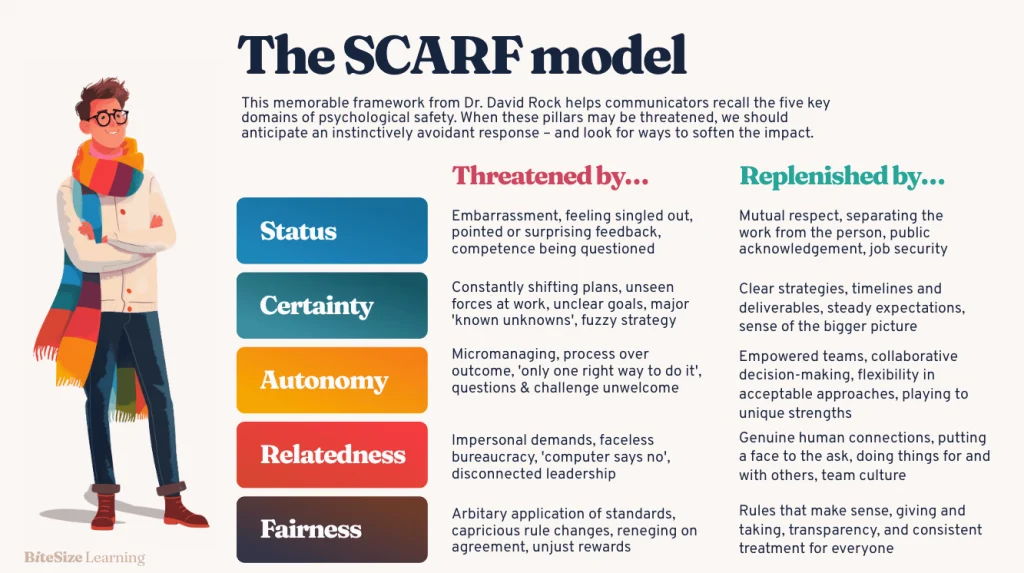
An accessible version of this chart can be found at BiteSize Learning, the original author of the graphic. BiteSize Learning offers additional resources and examples of how to apply SCARF in your daily work.