

Part of Term Resources

Part of Term at UNCG
Part of Term, or accelerated-format, courses are a popular option for many learners and instructors. Accelerated format courses allow learners to engage in content deeply for a concentrated time, while progressing through their coursework in 7 week segments. While accelerated format courses offer a great deal of benefits, they are not ideal for every course and discipline. Accelerated courses come with unique challenges, such as balancing pace and rigor, but have many benefits, such as degree efficiency and student satisfaction.
Understanding Part of Term and Course load
Course WorkLoad by Credit Hour
| Weeks* | Course Credit Hours | Instructional Time Per Week | Out of Class Work Time Per Week** | Total Time on Task for Online Format Per Week |
|---|---|---|---|---|
| 15 | 1 | 50 minutes | 1 hour, 40 minutes | 2 hours, 30 minutes |
| 15 | 2 | 1 hour, 40 minutes | 3 hours, 20 minutes | 5 hours |
| 15 | 3 | 2 hours, 30 minutes | 6 hours | 8 hours, 30 minutes |
| 15 | 4 | 3 hours, 20 minutes | 6 hours, 40 minutes | 10 hours |
| 7 | 1 | 1 hour, 47 minutes | 3 hours, 34 minutes | 5 hours, 21 minutes |
| 7 | 2 | 3 hours, 34 minutes | 7 hours, 9 minutes | 10 hours, 43 minutes |
| 7 | 3 | 5 hours, 21 minutes | 10 hours, 43 minutes | 16 hours, 4 minutes |
| 7 | 4 | 7 hours, 5 minutes | 14 hours, 17 minutes | 21 hours, 26 minutes |
| 12 hours, 48 minutes (750 minutes) of instruction per a credit total for the course. | 2:1 ratio with weekly instruction time | Instructional Time + Out of Class Work Time per a week |
**Note: Out of class work time per a credit hour for Graduate courses often exceeds 2 hours per a week and depend on course level, disciplinary standards, and subject matter complexity.
Workload Calculator
Wake Forest University offers a free Workload Calculator that estimates time for student completion of delivered content, reading, writing assignments, discussion activities, and assessments.
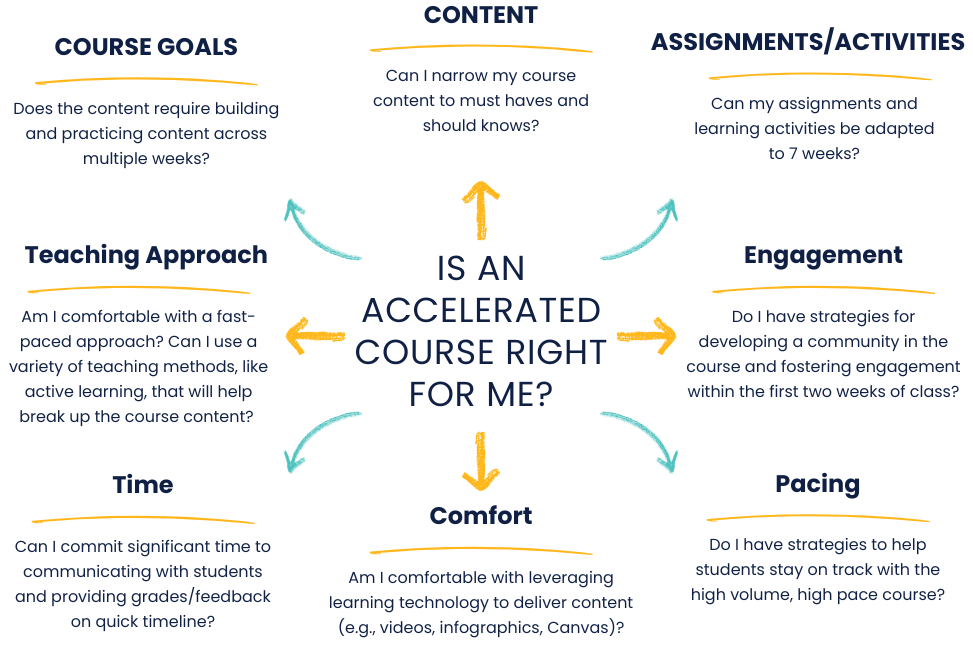
Am I ready to Teach an Accelerated Course?
Designing Accelerated Format Courses
Course Maps
Course Maps provide an overview of how course content items are interconnected, what revisions are needed, and action plans for addressing gaps.
*Course Maps are adapted from the “IDL6543 Planning Worksheet: Course Map,” part of the IDL6543 course prepared by the University of Central Florida Center for Distributed Learning (UCF-CDL), licensed under a Creative Commons Attribution-ShareAlike 4.0 International License
Converting 15 Week Course to aN Accelerated Format
Review Learning Outcomes and Context
Step 1: Review program and course level goals to ensure that they can be met with an accelerated timeline.
Successful accelerated format courses require that module objectives and learning assessments tightly align with course level outcomes.
REorganize Content
Step 2: Review course topics and content to cluster related topics in a logical scaffolded approach.
Combining overlapping course material and scaffolding complex topics over several weeks can ensure student progress in the accelerated timeline.
Organizing topics into three categories: Must Know, Should Know, and Nice to Know. Remove or adjust any topics that do not directly support the course learning outcomes.
Develop Assessments
Step 3: Review and adjust course assessments to ensure alignment with course and module-level objectives.
Consider scaffolding complex assessments. For example, instead of students completing 4 writing assignments, consider breaking one large writing assignment into 3-4 milestones and a final project.
Ensure a balance of formative and summative assessments. In a accelerated format, students require frequent, consistent, and timely formative feedback.
Design Learning Activities
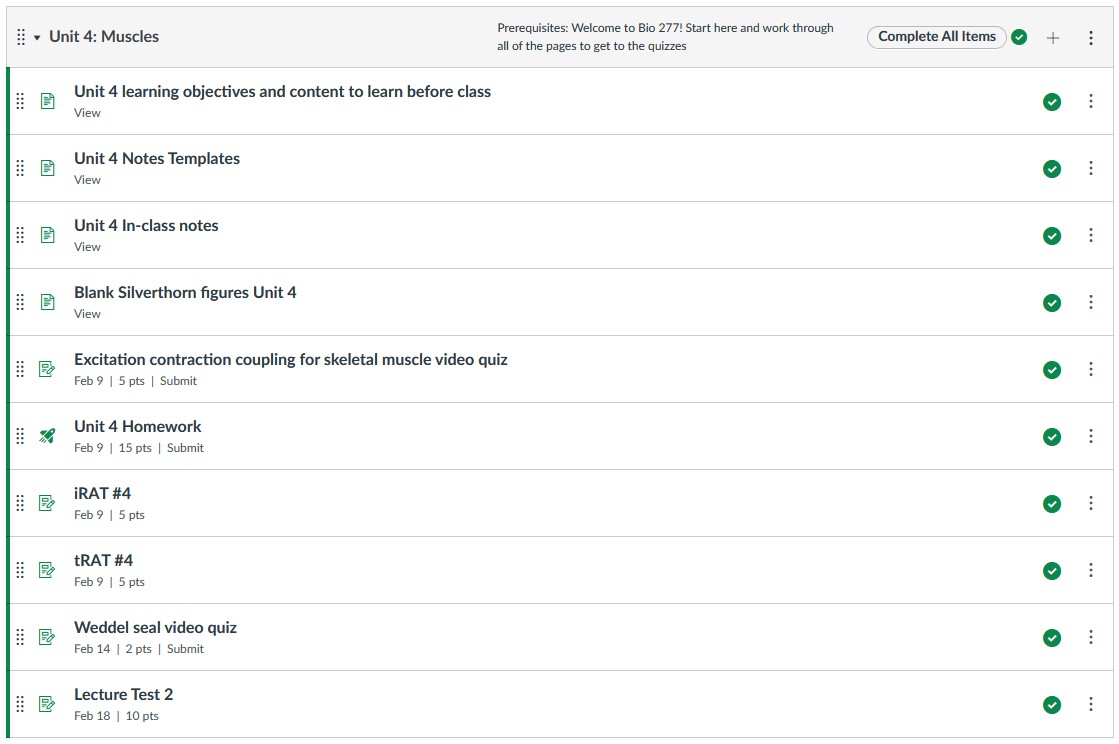
Step 4: Depending on the course’s modality, consider what teaching practices maximize instructional time.
In-person/Synchronous: Strategies such as flipped courses, active learning, and team-based learning can maximize instructional engagement.
Asynchronous: Strategies such as content chunking, videos with embedded quizzes, collaborative projects, and scaffolded discussion boards can maximize student engagement with content.
Select Content Delivery
Step 4: The shift to an accelerated format requires an efficiency of delivery that provides students with clear cadence for their learning.
Here are a few questions for consideration:
- When do you ask learners to pause and reflect during the learning process? How do you optimize reflection through consistent, regular intervals? Consider the cadence of knowledge check-ins and formative feedback.
- How will learners interact with one another? In an accelerated course, relationship building will need to structured early in the course.
- How can you present the content in meaningful ways other than the traditional lecture? Accelerated courses benefit from multiple presentations of content. Consider options like infographics and diagrams, concept maps, annotated slide presentations, guided note taking.
- Have you created a weekly cadence for course announcements, assignments, interactions, and feedback? Accelerated courses benefit from a routine rhythm, such as general announcements on Mondays, assignments due on Sundays, discussion boards due on Thursdays, etc. Creating a rhythm for the course help prevent learners from falling behind and know what to expect.
Incorporate Student Success Strategies
Step 5: The fast pace of an accelerated course has many benefits, like concentrated time on content. However, accelerated courses often require students to grasp concepts more quickly than a traditional course. Learners are more likely to engage with campus support, such as tutoring and academic support, when it is normalized as an expectation of success in the course.
Here are a few campus support structures to consider including in your course resources:
- STEM Learning Center providing free tutoring to UNCG students enrolled in a wide range of STEM-focused courses, such as Mathematics, Biology, Chemistry and more.
- Academic Achievement Center offers tutoring, academic coaching, and workshops on learning skills.
- Communications Lab focuses on both speaking and writing, and provides communication support for students, faculty, and staff through one-on-one and group sessions focusing on dialogic feedback.
Resources for accelerated Format Courses
Research On Best Practices
William Kops’ (2013) Teaching Compressed-Format Courses: Teacher-based best practices documented common best practices for teaching accelerated courses. Reviewing highly rated summer accelerated summer courses, Kops outlines approaches to course planning, course delivery, learning assessment, and student engagement.
UNC-c’s SHort Course Resource
UNC-Charlotte offers Short Courses or Part-of-Term and has developed a resource page for consolidating and revising course content when moving from an 16 week to 7 week course.
UCF Accelerated Course Design Guide
The University of Central Florida (UCF) offers a detailed guide for designing new accelerated-format courses or converting longer courses.
Montclair State Planning Compressed Courses Guide
Montclair State University offers a detailed guide for planning compressed courses, including adjustments to course elements and content delivery.
Strategies for Designing and Delivering an Accelerated Course
Our friends at the University of Central Florida have created video resources for approaching the accelerated course process.
